Sojourner
Join the beta

Exercise · Core
Lying leg raise: how to do it, the muscles it works, and when to add weight
An isolation bodyweightexercise for the core. The cues, the muscles it works, how the app moves the weight up, and what to swap in.
Sojourner exercise film · tap to play
01
How to do it
There's no written step-by-step for this one in the app's guides yet; the cues above and the film carry it.
02
Muscles worked
The film colours each muscle by the job it does in the lift.
Primary
Abs: does the lifting.
Secondary
Rectus femoris and TFL: helps.
Steadying
Obliques and Adductors: holds you in position.
03
How Sojourner progresses it
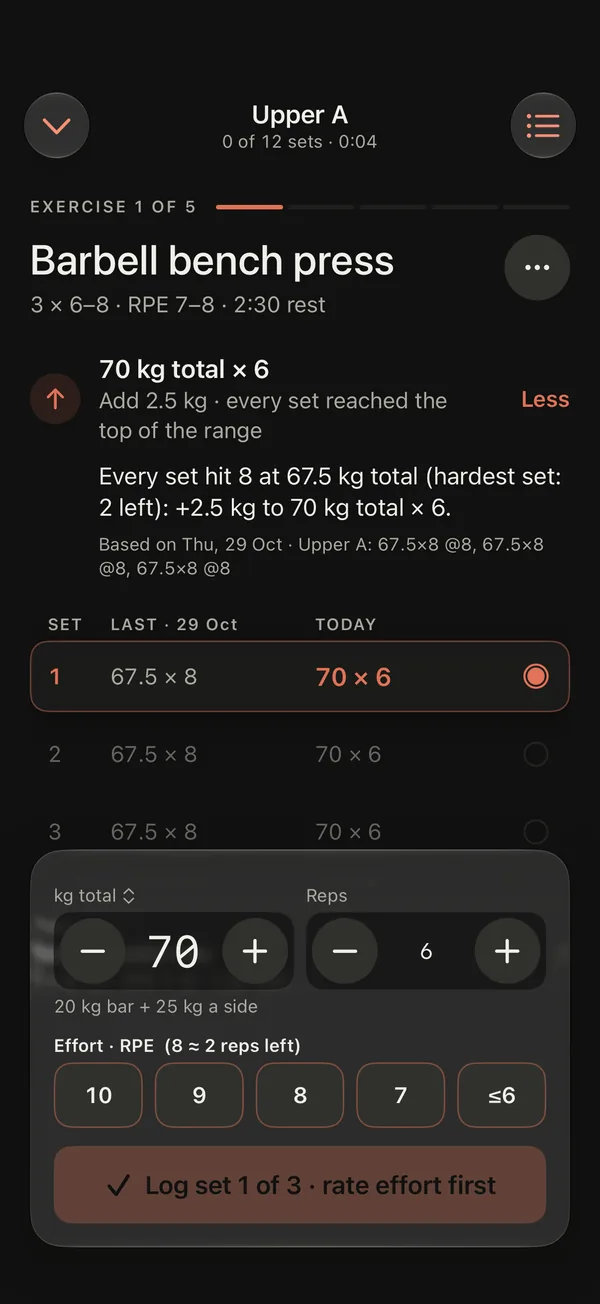
Added from the library, it starts as 3 × 10–15 at RPE 8 (2 reps left in the tank), 60 s rest and a weight step of 2.5 kg (5 lb if you log in pounds). The weight you log is bodyweight, plus any weight you add. Every number stays editable.
The rule is double progression: one more rep on your weakest set each session until every set reaches 15. At bodyweight there's no weight to add, so the app keeps asking for a rep more, up to 17; past that it suggests holding a weight (log it, and the next session builds from it) or a harder variation.
What the app says after the last session in that example: “Every set hit 15 at bodyweight: aim for 16.”
04
What to swap it for
When the space is taken, Gym mode offers swaps for today from the same muscle group and the same kind of movement, filtered to the equipment you have. The plan stays as written. For the lying leg raise:
- Crunch
- Decline crunch
- Reverse crunch
- Bicycle crunch
- Sit-up
- Decline sit-up
- V-up
- Hanging leg raise
Sojourner: Habits & Training
Get the next weight worked out on every set.
Sojourner applies this rule to every set you log and tells you why. Free iPhone beta on TestFlight, no account.
TestFlight public beta · iOS 26 or later · Android in development