Sojourner
Join the beta

Training guide
Double progression: when to add weight, with a calculator
Pick a rep range. Keep the weight until every set reaches the top of it, then add the smallest step you can and start again from the bottom. That's double progression, and the calculator below applies it to your last session.
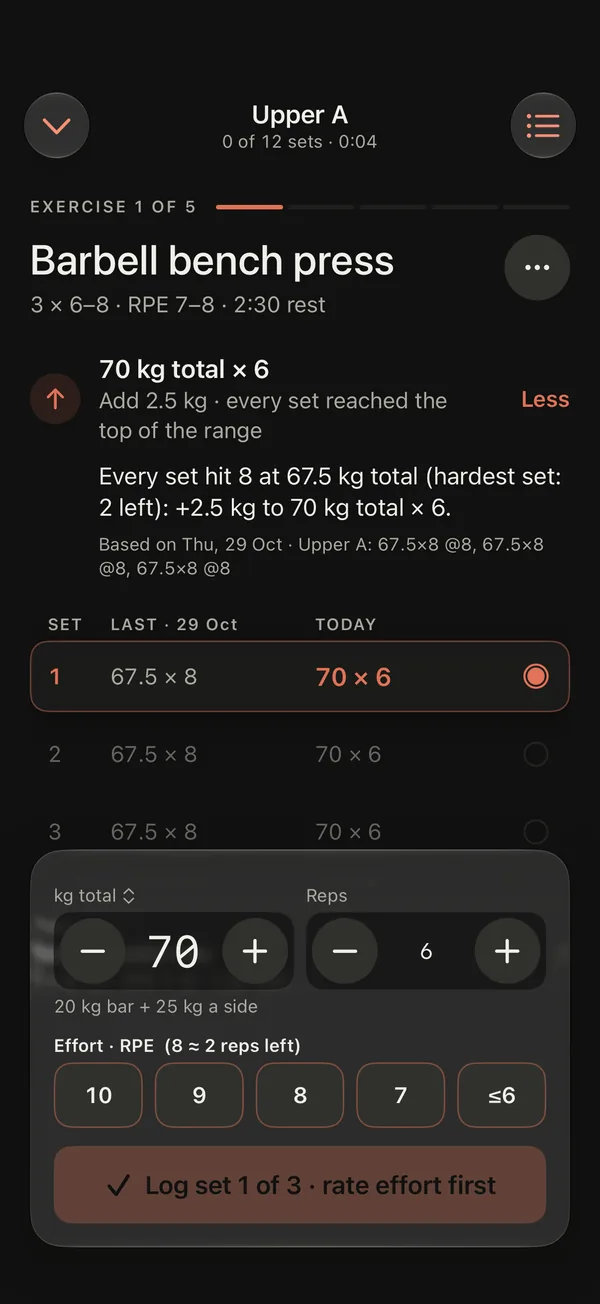
Actual app · sample journey
What should I lift next time?
Fill in the plan and what you did last session at your working weight. Nothing you type leaves this page.
The calculator needs JavaScript. The rule it applies is spelled out below.
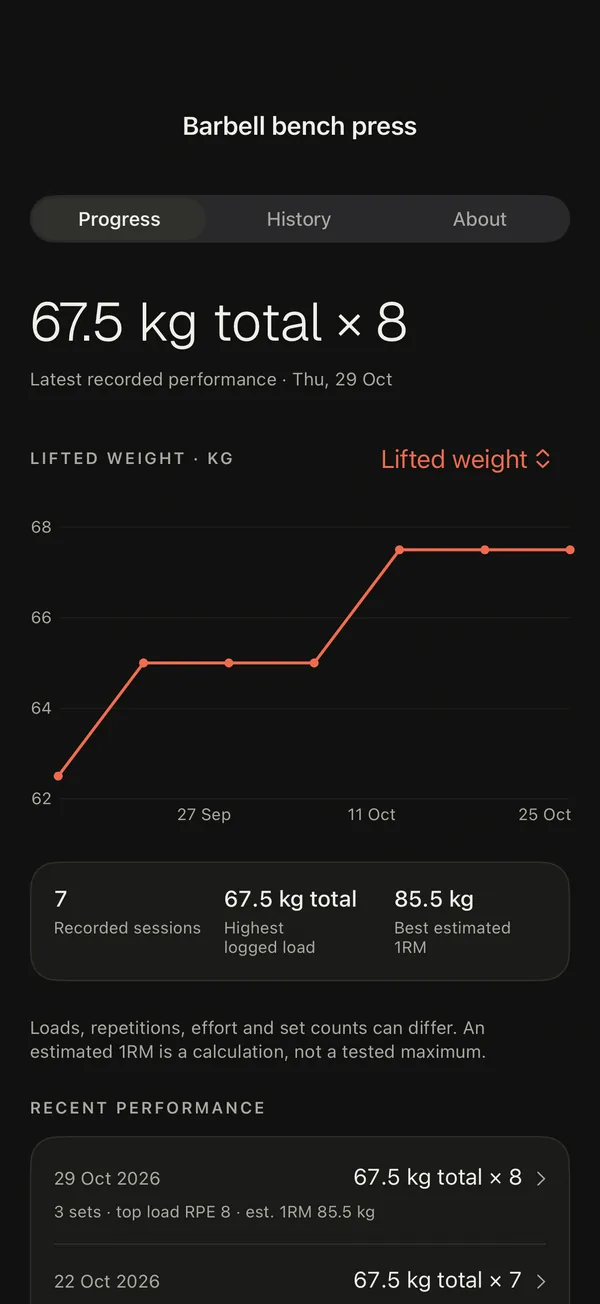
Actual app · sample journey
01
How double progression works
Take a plan of 3 sets of 8–12 reps. You find a weight you can lift for 8 good reps with two or three left in the tank: say 135 lb.
- Same weight, more reps. Next time, beat the weakest set by one rep. If your sets went 10, 9, 9, aim for 10 on every set.
- Every set at the top? When all three sets reach 12, add the smallest step your equipment allows (5 lb here) and go back to 8.
- Repeat. 140 lb for 8, 8, 8, then 9s, and so on up to 12s again.
The weight goes up only when the reps say it can. That's the whole idea, and it's why the method suits people who train on their own: the next target is never a guess.
| Session | Weight | Reps | Next |
|---|---|---|---|
| 1 | 135 lb | 10, 9, 9 | 135 lb, aim for 10 |
| 2 | 135 lb | 11, 10, 10 | 135 lb, aim for 11 |
| 3 | 135 lb | 12, 12, 12 | 140 lb × 8 |
| 4 | 140 lb | 9, 8, 8 | 140 lb, aim for 9 |
02
Why reps first, then weight
Adding reps at the same weight is real progress, not a waiting room.
In an 8-week trial with 43 trained lifters, one group added load while another added reps at a constant load, and both gained similar muscle and strength (Plotkin et al., 2022). The American College of Sports Medicine's 2009 guidance put the trigger in plain terms: increase the load by 2–10% "when the individual can perform the current workload for one to two repetitions over the desired number" (ACSM, 2009). Its 2026 overview of 137 reviews keeps progression as the requirement for continued gains, through load, volume or exercise choice, and doesn't prescribe a single increment (Currier et al., 2026).
What no study has done is compare exact trigger rules (all sets at the top, one set at the top, and so on). "Every set reaches the top" is a common, conservative choice, and it's the one used here.
03
How hard each set should be
Reps only mean something at a known effort. The usual way to rate it is reps in reserve: how many more reps you could have done. "2 left" is RPE 8, "1 left" is RPE 9, and "none left" is RPE 10 (Zourdos et al., 2016).
- RPE 82 reps left
- RPE 91 rep left
- RPE 10none left
You don't need to train to failure to progress. A meta-analysis of 15 studies found no clear muscle-growth advantage for failure over stopping short (Refalo et al., 2023), and the 2026 ACSM overview suggests 2–3 reps in reserve as a practical target (Currier et al., 2026).
People misjudge reps left by about one rep on average, usually guessing fewer than they had (Halperin et al., 2022). So the calculator only holds you back for effort when your hardest set was more than one rep harder than planned: if the plan said 2–3 left and you had 0, the weight and reps stay until the same work feels easier.
04
When the jump is too big
A fixed plate means different things at different weights. Five pounds is 2% of a 225 lb squat and 20% of a 25 lb dumbbell raise. So before adding weight, the calculator checks whether last session's reps (plus the reps you had left) can absorb the step, using the common rule of thumb that each rep is worth about 3.3% of load (the Epley estimate).
- 2%5 lb on a 225 lb squat
- 20%5 lb on a 25 lb dumbbell raise
If the step is too big, you keep adding reps, up to two above the range, then hold and use a smaller step (fractional plates, a lighter dumbbell increment, or a cable pin). This matches the "one to two repetitions over" idea above.
05
When to drop the weight
Rarely. The weight comes down by one step only when it fails the bottom of the range: no set could have reached it even counting the reps left, or every set went to failure and one still fell short. A bad set at the end of a session is normal and doesn't move anything. Missing reps at the bottom of the range keeps the weight and asks for the bottom number on every set first.
06
Common questions
How many reps should I add each session?
One on your weakest set is enough. Reps that come faster are welcome, but the target stays one above the weakest set so every set catches up.
What if I didn't do all my sets?
Then the weight holds. Progress counts only on the sets the plan asked for, all of them.
Does it work for bodyweight exercises?
Yes for reps. Once you're past the top of the range, add weight (a vest or a held dumbbell) or move to a harder variation.
Is this how Sojourner decides?
Yes. The calculator is the app's rule, rewritten for the web and checked against 67 of the app's own test cases. Inside the app it also knows your plan's phases (easy weeks hold the weight) and spots an off day against the session before.
07
Sources
- American College of Sports Medicine. Progression models in resistance training for healthy adults. Med Sci Sports Exerc. 2009;41(3):687–708.
- Currier BS, et al. Resistance training prescription for muscle function, hypertrophy, and physical performance in healthy adults: an overview of reviews. ACSM Position Stand. Med Sci Sports Exerc. 2026;58(4):851–872.
- Plotkin D, et al. Progressive overload without progressing load? The effects of load or repetition progression on muscular adaptations. PeerJ. 2022;10:e14142.
- Refalo MC, et al. Influence of resistance training proximity-to-failure on skeletal muscle hypertrophy. Sports Med. 2023;53(3):649–665.
- Halperin I, et al. Accuracy in predicting repetitions to task failure in resistance exercise. Sports Med. 2022;52(2):377–390.
- Zourdos MC, et al. Novel resistance training-specific rating of perceived exertion scale measuring repetitions in reserve. J Strength Cond Res. 2016;30(1):267–275.
Sojourner: Habits & Training
Get this answer on every set, automatically.
Sojourner suggests the next weight for each exercise from your last session and tells you why. Free iPhone beta on TestFlight, no account.
TestFlight public beta · iOS 26 or later · Android in development