Sojourner
Join the beta

Exercise · Triceps
Overhead dumbbell triceps extension: how to do it, the muscles it works, and when to add weight
An isolation dumbbell exercise for the triceps, in 2 of Sojourner's starting plans. The cues, the muscles it works, how the app moves the weight up, and what to swap in.
01
How to do it
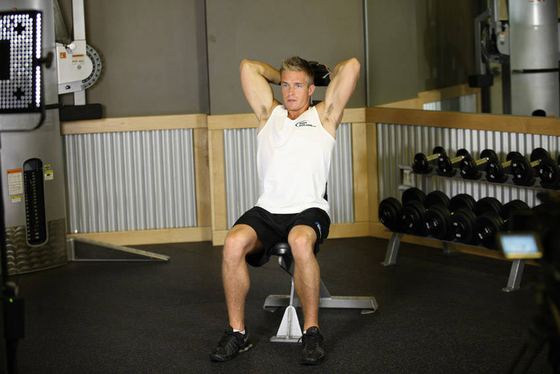
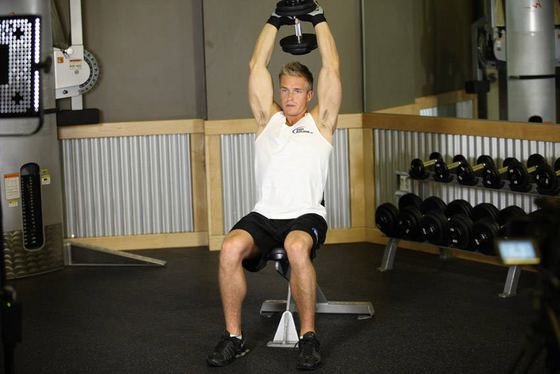
- Sit down on a bench with back support and grasp a dumbbell with both hands and hold it overhead at arm's length. Tip: a better way is to have somebody hand it to you especially if it is very heavy. The resistance should be resting in the palms of your hands with your thumbs around it. The palm of the hand should be facing inward. This will be your starting position.
- Keeping your upper arms close to your head (elbows in) and perpendicular to the floor, lower the resistance in a semi-circular motion behind your head until your forearms touch your biceps. Tip: The upper arms should remain stationary and only the forearms should move. Breathe in as you perform this step.
- Go back to the starting position by using the triceps to raise the dumbbell. Breathe out as you perform this step.
- Repeat for the recommended amount of repetitions.
Steps and photos: Free Exercise DB, public domain (Unlicense), as bundled in the app.
02
Muscles worked
Primary
Triceps.
In Sojourner it counts toward your week's triceps sets; the Train tab flags a muscle under 10 sets a week.
03
How Sojourner progresses it
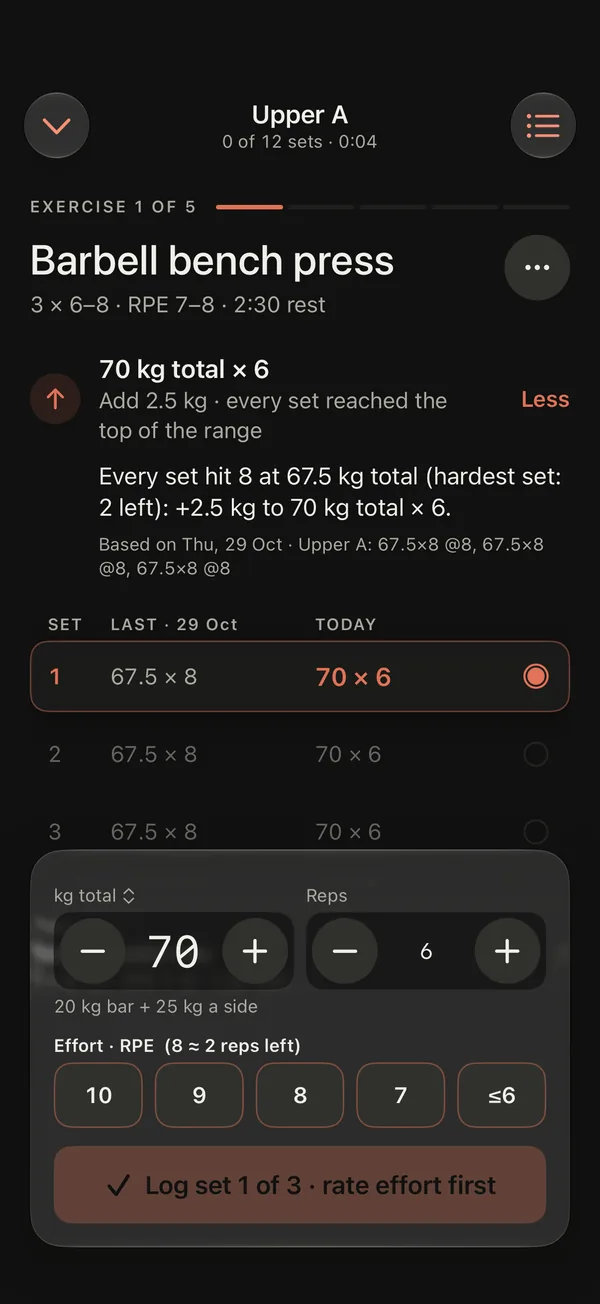
Added from the library, it starts as 3 × 10–15 at RPE 8 (2 reps left in the tank), 60 s rest and a weight step of 2.5 kg (5 lb if you log in pounds). The weight you log is one dumbbell, held in both hands. Every number stays editable.
The rule is double progression: keep the weight and add reps until every working set reaches 15 at the planned effort, then add 2.5 kg and go back to 10. The weight drops one step only when no set reaches 10, and one bad day at a weight you've handled before doesn't count. How the rule works, with a calculator.
What the app says after the last session in that example: “Every set hit 15 at 8 kg, but +2.5 kg (+31%) is too big a jump for those reps: same weight, aim for 16 first.”
A 2.5 kg jump is a big share of a light weight, so the app adds reps past the top first (up to 17) and, if the jump is still too big, suggests a smaller step. Lighter dumbbells or a micro-plate fix it.
04
What to swap it for
When the dumbbell is taken, Gym mode offers swaps for today from the same muscle group and the same kind of movement, filtered to the equipment you have. The plan stays as written. For the overhead dumbbell triceps extension:
- Dumbbell skull crusher
- Single-arm overhead dumbbell extension
- Dumbbell kickback
- Triceps rope pushdown
- Straight-bar pushdown
- V-bar pushdown
- Reverse-grip pushdown
- Single-arm cable pushdown
05
In the starting plans
| Plan | Day | Prescription |
|---|---|---|
| Home: dumbbells | Home C (Friday) | 3 × 10–15 |
| Bro split | Arms (Friday) | 3 × 10–15 |
Sojourner: Habits & Training
Get the next weight worked out on every set.
Sojourner applies this rule to every set you log and tells you why. Free iPhone beta on TestFlight, no account.
TestFlight public beta · iOS 26 or later · Android in development