Sojourner
Join the beta

Food guide
When to adjust your calorie deficit: a weekly check-in rule
Cutting calories every time the scale stalls for three days is how diets get too hard to keep. A weekly check-in with a few clear rules changes less, and only when the trend says so.
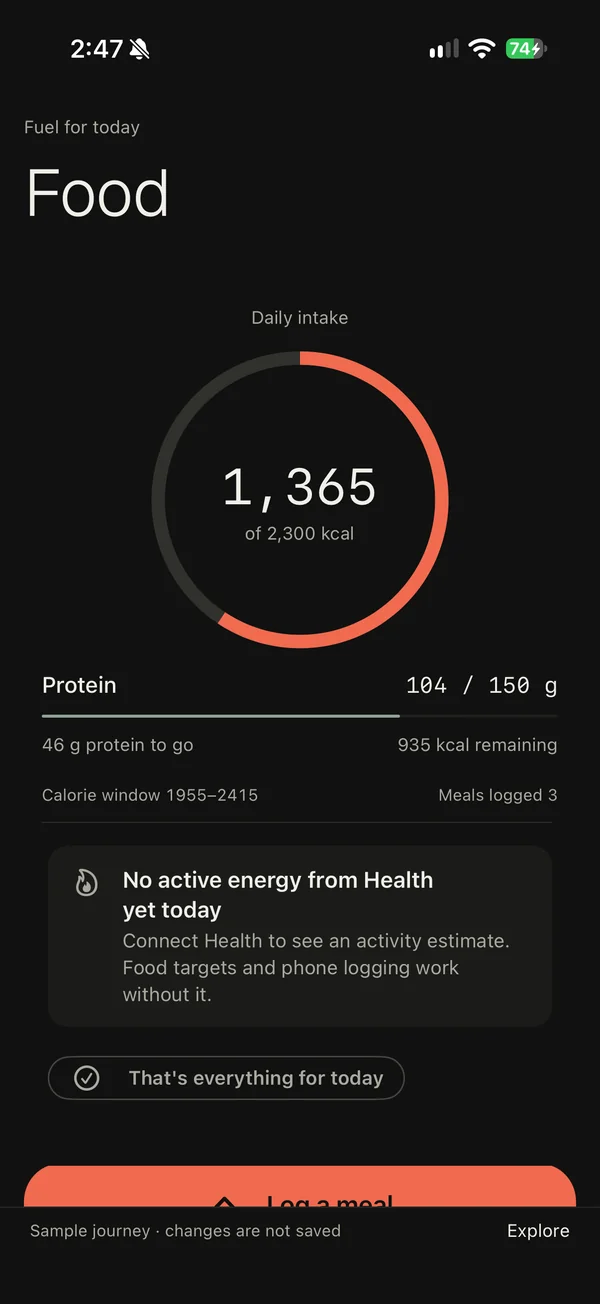
Actual app · sample journey
01
Compare weekly averages, not days
Your weight moves from day to day with water, salt and what's still in your gut, and it follows the week. In one study of 80 adults who weighed themselves daily, weight rose over the weekend and fell during the week (Orsama et al., 2014). So any single morning can mislead you. Weigh in most days and compare the average of this week with the average of last week.
02
Check your logging before you cut
If the trend has stalled, look at the food log before the target. People tend to under-record what they eat. In a classic study of ten people who said they couldn't lose weight on under 1,200 kcal a day, they under-reported what they actually ate by 47% on average: roughly half their food went unrecorded (Lichtman et al., 1992). That was a small, specific group, but the lesson travels: missed snacks, cooking oil and weekend meals add up. A day you didn't log isn't a day you ate nothing.
03
How fast is fast enough?
There isn't one right rate. For people who lift and want to keep their muscle while losing fat, a review of evidence for natural bodybuilders recommended losing roughly 0.5 to 1% of body weight per week (Helms et al., 2014). That range is chosen to keep as much muscle as possible; it isn't a target everyone must hit.
04
Change in small steps, then wait
Body weight responds slowly to a lasting change in what you eat: in Hall and colleagues' model, the response has a half-time of about a year (Hall et al., 2011). The practical upshot: a small adjustment needs weeks to show up on the scale, so make one, then give it time before making another.
05
The rule, in one table
This is the weekly check-in Sojourner uses for weight-loss goals. It's a cautious product rule built on the points above, not a clinical protocol.
- −150 kcala day, when you lose under 0.25 kg a week two weeks running and your logs were complete
- +100 kcala day, when you lose over 1 kg a week or your lifts slip
- 1,600 kcalthe floor: never below it
| What the 7-day averages show | What changes |
|---|---|
| Losing under 0.25 kg (about 0.5 lb) a week, two weeks running | Eat 150 kcal a day less, but only if your food logs were mostly complete and near target, and at least 14 days after the last change took effect |
| Losing over 1 kg (about 2.2 lb) a week, or losing fast while your lifts slip | Eat 100 kcal a day more |
| Anything in between | Nothing |
| Any change | Never below 1,600 kcal a day |
06
When to get help instead
Don't use a rule like this if you're pregnant or breastfeeding, have or have had an eating disorder, have a medical condition that affects weight or appetite, or take medicines that do (including GLP-1 drugs and insulin). Talk to a doctor or a registered dietitian. This guide is general information, not medical advice.
07
How Sojourner does it
You set calorie and protein targets. For a weight-loss goal, the weekly check-in compares your 7-day average weights and adjusts calories from the next day, following the table above. When you're well under target, Sojourner asks whether meals are missing instead of assuming you ate less, and protein you didn't record stays marked as unknown rather than zero. Gain and maintenance goals keep the target you chose.
08
Sources
- Orsama AL, et al. Weight rhythms: weight increases during weekends and decreases during weekdays. Obes Facts. 2014;7(1):36–47.
- Lichtman SW, et al. Discrepancy between self-reported and actual caloric intake and exercise in obese subjects. N Engl J Med. 1992;327(27):1893–1898.
- Helms ER, Aragon AA, Fitschen PJ. Evidence-based recommendations for natural bodybuilding contest preparation: nutrition and supplementation. J Int Soc Sports Nutr. 2014;11:20.
- Hall KD, et al. Quantification of the effect of energy imbalance on bodyweight. Lancet. 2011;378(9793):826–837.
Sojourner: Habits & Training
The check-in, done for you.
Sojourner compares your 7-day average weights each week and suggests a small change only when the trend and your logging support it. Free iPhone beta on TestFlight, no account.
TestFlight public beta · iOS 26 or later · Android in development