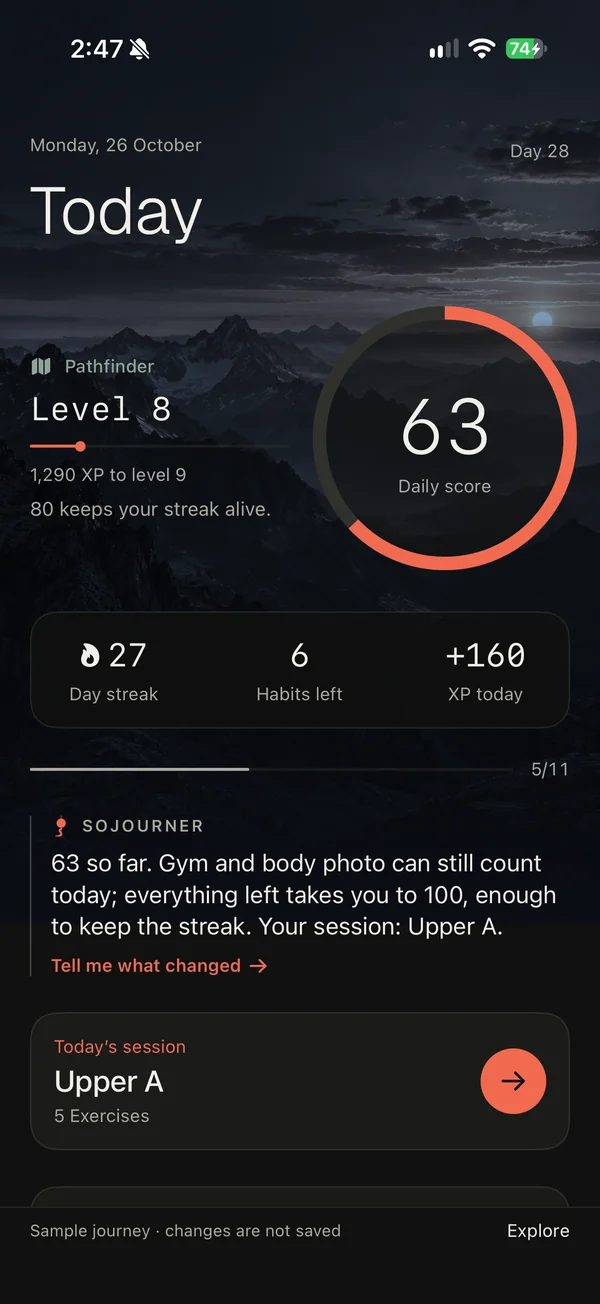
Sojourner
Join the beta

Sleep guide
How to go to bed earlier, a little at a time (with a planner)
Deciding to sleep at 11 PM tonight when your body is used to 1:30 AM usually means lying awake. Moving bed and alarm together, a small step every few days, gives your body clock time to follow. The planner below lays out the dates.
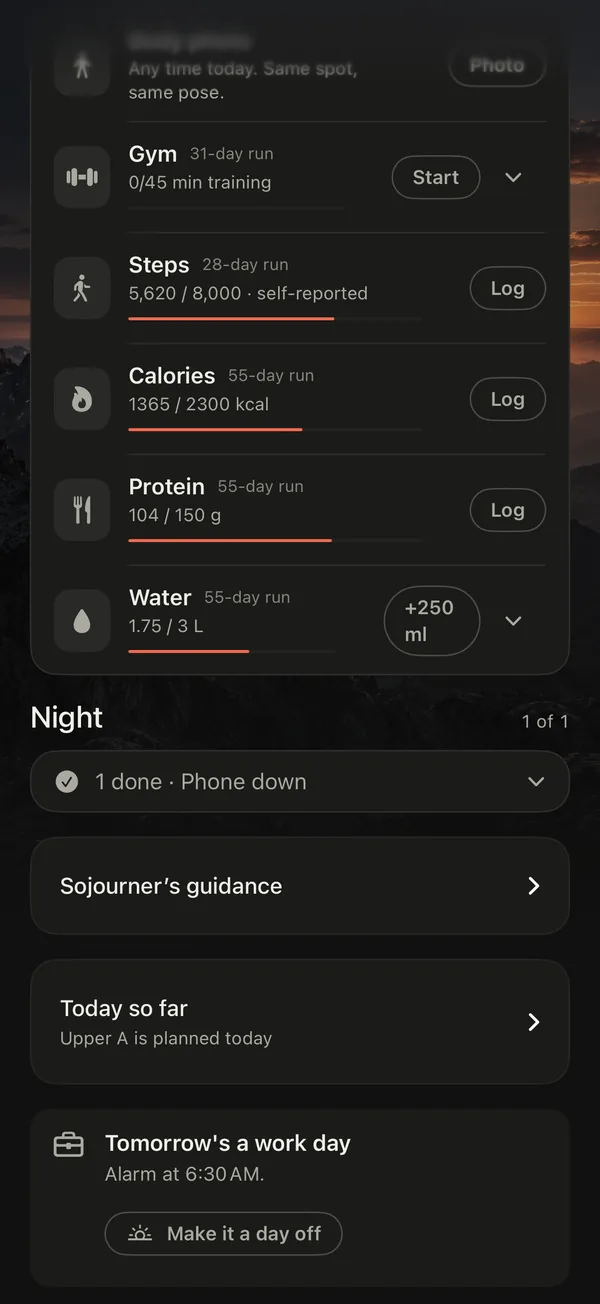
Actual app · sample journey
Plan your steps
Start from when you really sleep now, not when you wish you did. Nothing you type leaves this page.
The planner needs JavaScript. The method is spelled out below.
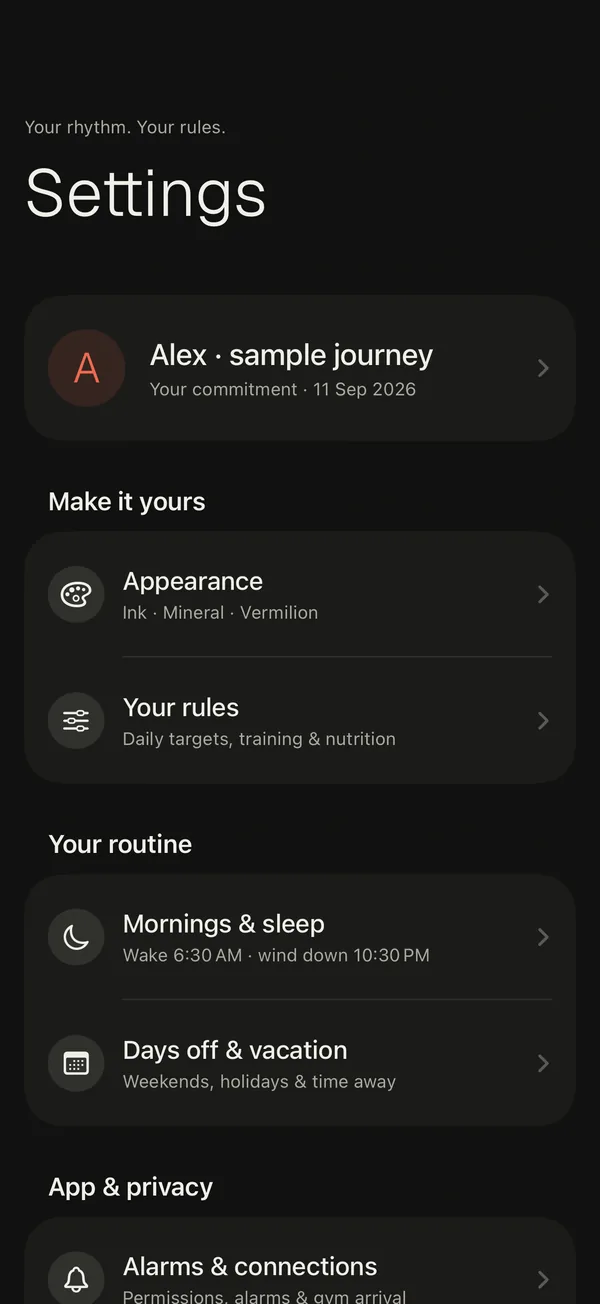
Actual app · sample journey
01
An example
From asleep at 1:00 AM and up at 8:30 AM, to 11:00 PM and 7:00 AM, in 20-minute steps every 3 days. That's 6 steps over 18 days when every morning goes to plan. The alarm reaches 7:00 AM first and stays there while bedtime finishes the climb.
| Step | From day | Bed | Alarm |
|---|---|---|---|
| Start | 0 | 1:00 AM | 8:30 AM |
| 1 | 3 | 12:40 AM | 8:10 AM |
| 2 | 6 | 12:20 AM | 7:50 AM |
| 3 | 9 | 12:00 AM | 7:30 AM |
| 4 | 12 | 11:40 PM | 7:10 AM |
| 5 | 15 | 11:20 PM | 7:00 AM |
| 6 | 18 | 11:00 PM | 7:00 AM |
A morning you oversleep holds the current step, so the real dates usually run a little later.
02
The method
- Start where you are. Use the times you actually fall asleep and get up on most days.
- Move the alarm too. Bed and alarm step earlier together, so the time you have in bed stays about the same. Going to bed earlier while still waking late just adds time lying awake.
- Small steps, every few days. 15 to 30 minutes, every 2 to 4 days. Each time reaches its goal and stops there.
- Only step after on-time mornings. If you overslept on more than one day of a step, stay on that step until you manage it. The next step is easier from solid ground.
- Get light in the morning, keep evenings dim. Bright light soon after waking moves the body clock earlier; bright light late in the evening moves it later (Khalsa et al., 2003).
03
Why not just go to bed earlier tonight?
Your sleep timing follows a body clock that shifts gradually. In a lab study, researchers moved people's sleep an hour earlier each day, but they paired it with bright morning light from a light box and melatonin in the afternoon (Crowley & Eastman, 2015). At home, without that setup, smaller steps are a cautious choice. To be clear about the evidence: no trial has compared 15-, 20- or 30-minute steps for people shifting their schedule on their own. The step sizes here are a sensible pace, not a proven one.
04
How much sleep to aim for
For adults 18 to 60, the American Academy of Sleep Medicine and the Sleep Research Society recommend 7 hours or more per night on a regular basis (Watson et al., 2015). The planner warns you when your goal leaves less than 7 hours in bed. Time in bed isn't time asleep, so leave some margin.
05
Weekends and days off
A much later night on the weekend pulls the schedule back. Sojourner allows one hour later before a day off, with no alarm the morning after. If you're mid-ladder, keep days off close to your current step.
06
When it isn't a habit problem
Some people can't fall asleep earlier however tired they are, for weeks, even with a regular routine. Delayed sleep-wake phase disorder is a recognised condition with its own treatments (Auger et al., 2015). Talk to a doctor if that sounds like you, or if you have trouble falling or staying asleep most nights, snore loudly, or feel very sleepy during the day despite enough time in bed. This guide is general information, not medical advice.
07
How Sojourner does it
In Sojourner, the bedtime ladder works exactly like the planner: you enter where you really are and where you're headed, pick 15, 20 or 30 minutes and 2 to 4 days per step, and bed and alarm move a step earlier only when you were up on time on all but one of its days. The wake-up alarm stops asking once a photo taken outdoors is checked on your iPhone, and a morning light habit can count your time in daylight from Apple Health. Days off have no alarm and allow bedtime an hour later.
08
Sources
- Khalsa SBS, Jewett ME, Cajochen C, Czeisler CA. A phase response curve to single bright light pulses in human subjects. J Physiol. 2003;549(Pt 3):945–952.
- Crowley SJ, Eastman CI. Phase advancing human circadian rhythms with morning bright light, afternoon melatonin, and gradually shifted sleep: can we reduce morning bright-light duration? Sleep Med. 2015;16(2):288–297.
- Watson NF, et al. Recommended amount of sleep for a healthy adult: a joint consensus statement of the American Academy of Sleep Medicine and Sleep Research Society. J Clin Sleep Med. 2015;11(6):591–592.
- Auger RR, et al. Clinical practice guideline for the treatment of intrinsic circadian rhythm sleep-wake disorders. J Clin Sleep Med. 2015;11(10):1199–1236.
Sojourner: Habits & Training
A ladder that only climbs when you do.
Sojourner moves your bedtime and alarm earlier one step at a time, and only after you were up on time. Free iPhone beta on TestFlight, no account.
TestFlight public beta · iOS 26 or later · Android in development