Sojourner
Join the beta

Habits guide
Missed a day? Why your streak shouldn't reset to zero
A streak that resets to zero after one bad day turns a slip into a reason to quit. A better rule counts a day as kept when it's good enough, and decides in advance what good enough means.
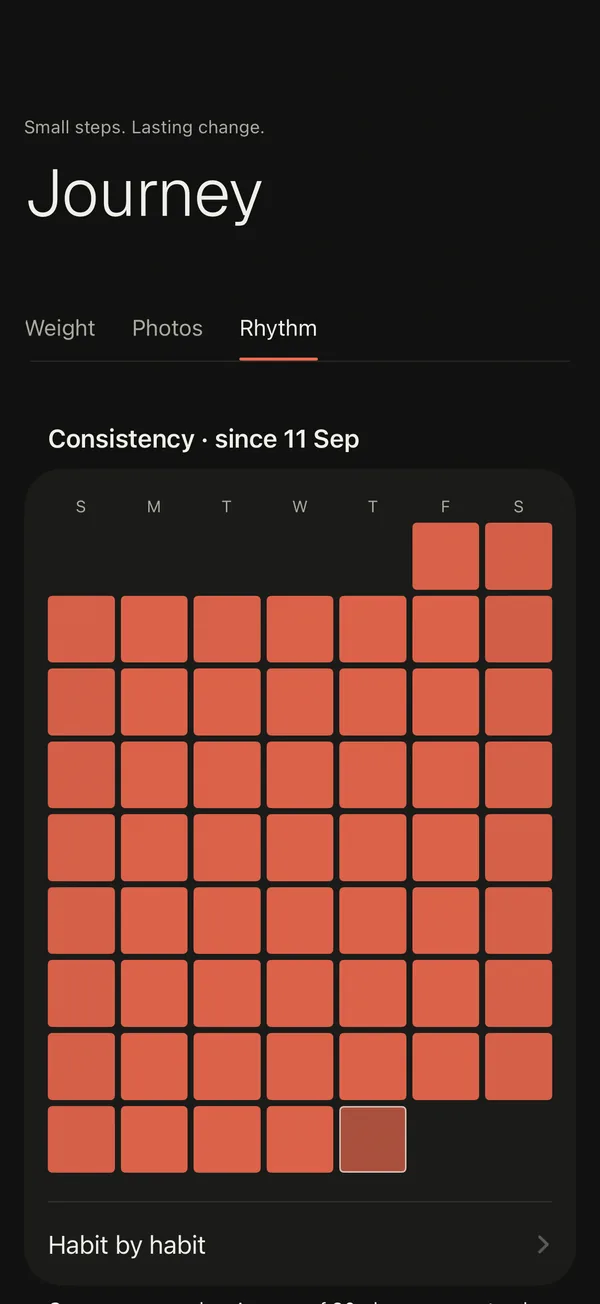
Actual app · sample journey
01
One missed day doesn't undo a habit
The best-known study of how habits form followed 96 people for 12 weeks as each repeated an eating, drinking or activity behaviour they'd chosen, once a day in the same situation. Missing a single opportunity didn't materially affect how automatic the habit became (Lally et al., 2010). The same study is where the often-quoted "66 days" comes from, and the spread is the more useful part: for the people whose data fit the model, reaching near-full automaticity took anywhere from 18 to 254 days. Habits are slow, uneven, and forgiving of a single miss.
What does the damage is the story the reset tells: "I broke it, so it doesn't count any more." That's the moment people stop.
02
Decide what a good-enough day is, before you need it
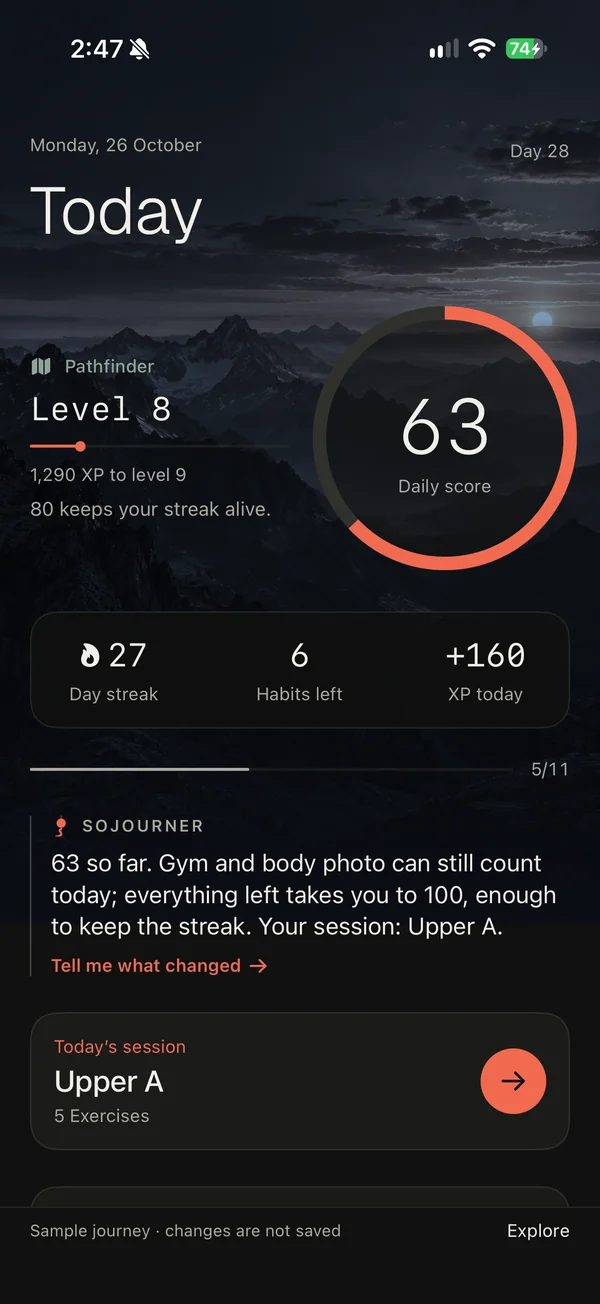
Pick a handful of habits and give the important ones more weight. Then set the bar for a kept day below perfect, so that one slip is absorbed but a lost day isn't. That's how Sojourner works: each habit you choose adds points to the day, and a day at 80 or more keeps the streak. Try it with your own habits.
Build your good-enough day
Uses Sojourner's own points. In the app, amounts like steps or water also earn partial credit; here each habit is simply done or missed.
The builder needs JavaScript. The rule is explained above and below.
03
Why the weights matter
If every habit counted the same, missing your workout would cost as much as forgetting to log water. Sojourner gives the basics that hold a day together (waking up, training, sleep) the most points, and the small logging habits the least. With the full checklist, that means:
- One basic can slip and the streak survives, but not one basic plus anything else.
- Food and steps alone never break it, even if you miss all three.
- A rest day counts as following the plan, so the same rule holds on Sunday as on Monday.
- Days off ask less of the morning: morning light counts half, and there's no alarm.
Some examples with the full checklist (every habit except runs), on a gym day:
| Missed | Score | Streak |
|---|---|---|
| Nothing | 100 | Kept |
| Water | 94 | Kept |
| Phone down | 91 | Kept |
| Calories, protein and steps | 87 | Kept |
| Weigh-in and body photo | 84 | Kept |
| Gym | 82 | Kept |
| Sleep | 82 | Kept |
| Wake-up and steps | 79 | Broken |
| Gym and water | 77 | Broken |
A shorter list makes each habit count for more. With only wake-up, gym, steps, protein, water and sleep, missing the gym scores 72, and the streak breaks.
You don't need the app to use the idea. On paper: list four or five habits, mark one or two as the ones that matter most, and decide that a day counts if you did the important ones and most of the rest.
04
What about "never miss twice"?
It's a good rule of thumb for the day after a slip. The trouble with it on its own is that it doesn't say what a miss is: a skipped workout and a forgotten glass of water are different days. A weighted, good-enough score answers that before the bad day arrives, and two thin days in a row show up on their own.
05
How Sojourner does it
You pick your daily habits, from wake-up and morning light to gym, steps, calories, protein, water, phone down and sleep. Today turns them into one score and shows the one thing to do next. A day at 80 or more keeps your streak. Days off and vacations get a lighter checklist instead of a broken streak.
06
Sources
- Lally P, van Jaarsveld CHM, Potts HWW, Wardle J. How are habits formed: modelling habit formation in the real world. Eur J Soc Psychol. 2010;40(6):998–1009.
Sojourner: Habits & Training
A streak that survives a bad day.
Sojourner turns the habits you choose into one daily score, and a day at 80 or more keeps the streak. Free iPhone beta on TestFlight, no account.
TestFlight public beta · iOS 26 or later · Android in development