Sojourner
Join the beta

Training tool
One-rep max calculator: estimate your 1RM from any set
Your estimated one-rep max is the weight times (1 + reps ÷ 30), the Epley formula. A set of 185 lb for 5 reps gives about 216 lb. It's most accurate from a hard set of about 3 to 6 reps, and rough past 10.
Actual app · sample journey
What's my one-rep max?
Enter one hard set: the weight and the reps you did. Nothing you type leaves this page.
The calculator needs JavaScript. The formula and a worked example are below.
01
How it's calculated
The Epley formula: estimated 1RM = weight × (1 + reps ÷ 30). A single is already your one-rep max, so one rep returns the weight itself.
A worked example: 185 lb for 5 reps is 185 × (1 + 5 ÷ 30) = 215.8 lb. Turned round, the same formula gives the weight you could lift for any other number of reps:
| Reps | Weight | % of 1RM |
|---|---|---|
| 1 | 215 lb | 100% |
| 2 | 200 lb | 94% |
| 3 | 195 lb | 91% |
| 4 | 190 lb | 88% |
| 5 | 185 lb | 86% |
| 6 | 175 lb | 83% |
| 8 | 170 lb | 79% |
| 10 | 160 lb | 75% |
| 12 | 150 lb | 71% |
Weights are rounded down to the nearest 5 lb, the way you'd load them.
02
How accurate is it?
Close for low reps, rougher for high ones. In a study of 70 adults on the bench press and leg press, estimates from a 5-rep max were the most accurate, and the authors advise using no more than 10 reps for a linear estimate like this one (Reynolds et al., 2006). So:
- Use a hard set of about 3 to 6 reps. The closer to failure, the better the estimate.
- Treat sets over 10 reps as a rough guide. Sojourner's strength chart only uses sets of 1 to 10 reps for this reason.
- Count reps you had left. If you stopped with 2 reps in the tank, your set was really closer to a 7-rep max than a 5-rep one. The calculator shows that second estimate when you fill in "Reps left". People misjudge reps left by about one on average (Halperin et al., 2022), so it's an estimate of an estimate.
03
By lift
The same formula, with a chart of common weights for each of the four main barbell lifts:
04
Do you need to know your 1RM?
Not for most training. Programs written in percentages (like "3 × 5 at 75%") need a number to work from, and an estimate from a recent hard set does that job without the risk and fatigue of a true max attempt.
Plans that use double progression don't need it at all: you keep the weight until every set reaches the top of the rep range, then add the smallest step. Try it in the double progression calculator.
05
How Sojourner uses it
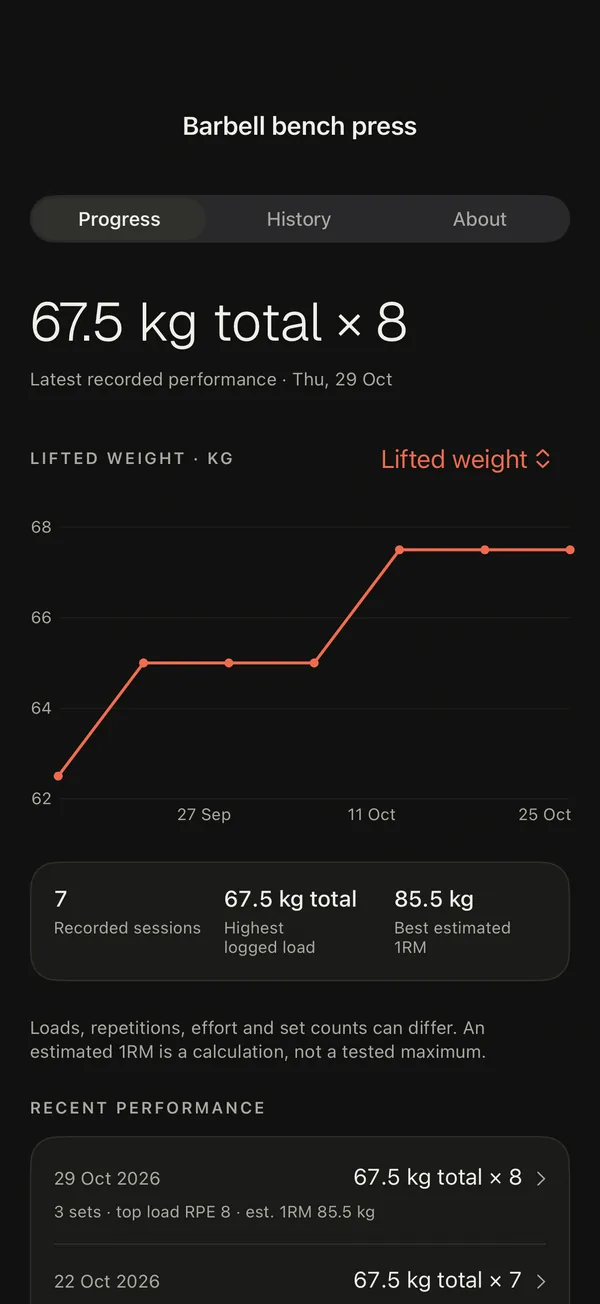
Sojourner keeps every set and charts each lift's estimated one-rep max over time, using the formula above on sets of 1 to 10 reps. It doesn't use the estimate to pick your weights: each set's suggestion comes from double progression, reps first and then a small step. The exception is Strength: foundations, whose squat, bench press, deadlift and overhead press run from a training max you set yourself: 3 sets of 5 at 75%, with the loads 5% higher in weeks 5–6.
06
Sources
- Reynolds JM, Gordon TJ, Robergs RA. Prediction of one repetition maximum strength from multiple repetition maximum testing and anthropometry. J Strength Cond Res. 2006;20(3):584–592.
- Zourdos MC, et al. Novel resistance training-specific rating of perceived exertion scale measuring repetitions in reserve. J Strength Cond Res. 2016;30(1):267–275.
- Halperin I, et al. Accuracy in predicting repetitions to task failure in resistance exercise. Sports Med. 2022;52(2):377–390.
Sojourner: Habits & Training
Your 1RM, tracked from every set.
Sojourner charts each lift's estimated one-rep max from the sets you log, and suggests the next weight. Free iPhone beta on TestFlight.
TestFlight public beta · iOS 26 or later · Android in development