Sojourner
Join the beta

Training guide
RIR vs RPE: how to rate effort on a set, with a chart
RIR and RPE measure the same thing. RIR (reps in reserve) is how many more reps you could have done with good form. RPE on a lifting scale is 10 minus that: 2 reps left is RPE 8, 1 left is RPE 9, none left is RPE 10. Use whichever you find easier to answer honestly; most people find \"how many more could I have done?\" easier.
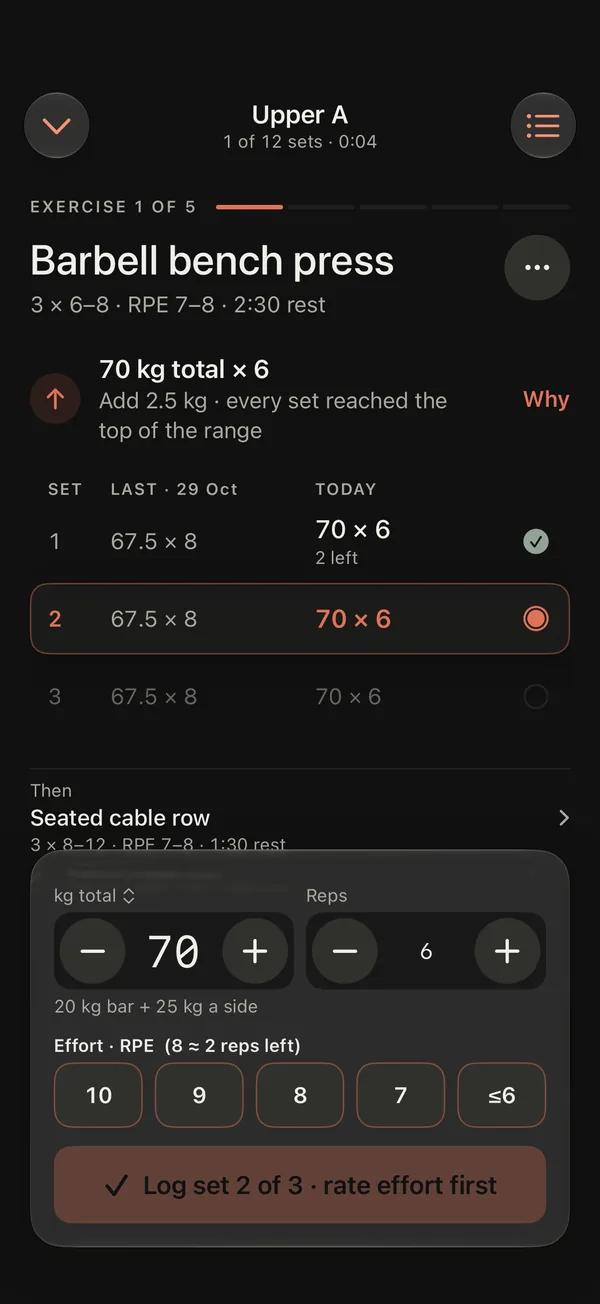
Actual app · sample journey
01
The chart
The lifting RPE scale was defined by reps in reserve (Zourdos et al., 2016; Helms et al., 2016). Read across:
| RPE | RIR (reps left) | Description on the scale |
|---|---|---|
| 10 | 0 | Maximum effort |
| 9 | 1 | 1 rep remaining |
| 8 | 2 | 2 reps remaining |
| 7 | 3 | 3 reps remaining |
| 5–6 | 4–6 | 4–6 reps remaining |
| 3–4 | — | Light effort |
| 1–2 | — | Little to no effort |
So a program that says "3×5 @ RPE 8" means three sets of five, each stopped with about two reps left. "3×8, 1–2 RIR" means RPE 8–9. Some programs also use half points, like RPE 8.5 for "one rep left, maybe two"; the published scale doesn't define them, so read a half point as between the two whole numbers.
02
Which one to use
They're interchangeable, so pick the question you can answer.
- RIR is easier for most people, especially newer lifters, because it's a count: "I did 8 and could have done 2 more."
- RPE is common in coached programs and powerlifting plans. If your program is written in RPE, rate in RPE so you don't convert in your head mid-session.
Far from failure, both get vague. That's why the scale lumps 4–6 reps left together: a range is easier to give once more than 3 reps are left.
03
How to rate a set honestly
- Rate it right after the set, before rest changes how it felt.
- Watch the last rep's speed. Slower reps went with higher ratings when the scale was tested (Zourdos et al., 2016). A rep that grinds is close to your last.
- Expect to be about one rep off. In a meta-analysis of 12 studies (414 people), lifters underestimated the reps they had left by about one on average (0.95). They were a little more accurate close to failure and on sets of 12 reps or fewer, and training experience made no clear difference (Halperin et al., 2022).
- Calibrate now and then. On a machine or a lift with safeties, take the last set to failure and compare the reps you got with the reps you thought you had left.
- Don't rate warm-ups. They aren't meant to be hard, and a rating there tells you nothing about progress.
04
How close to failure should you train?
Closer than most people think, but not to failure on every set.
- For strength, gains were similar across a wide range of reps in reserve in a 2024 series of meta-regressions (Robinson et al., 2024).
- For muscle size, the same analysis found growth improved as sets ended closer to failure. Its authors call it exploratory, because the RIR of each study had to be estimated.
- Going all the way to failure showed no clear advantage for muscle growth over stopping short in a 2023 meta-analysis (Refalo et al., 2023).
- A practical target: the 2026 ACSM overview suggests 2–3 reps in reserve (Currier et al., 2026).
For most working sets, that means RPE 7–9: hard, with one to three reps left.
05
Using effort to decide the next weight
Effort turns reps into a fair comparison. Eight reps at RPE 7 and eight reps at RPE 10 are different days. In double progression, you add weight once every set reaches the top of the rep range. Effort adds one check: if those reps took far more effort than planned, wait a session before adding weight.
Because ratings are about a rep off, a sensible rule ignores small misses. Hold back only when the hardest set was more than one rep harder than planned. If the plan said 2 left and you had 0, the weight holds until the same work feels easier.
06
How Sojourner does it
After each set, Sojourner asks how many more reps you could have done: 0, 1, 2, 3 or 4+. If you prefer RPE, switch the effort scale in training preferences and the same buttons read 10, 9, 8, 7 and 6 or lower. Either way it stores one number, RPE = 10 − reps left.
When a plan doesn't give an effort target, Sojourner assumes RPE 8 (2 reps left). Effort can only hold the weight back, never push it up: the weight goes up when every working set reaches the top of the range, unless your hardest set was more than one rep harder than planned. Warm-up sets carry no rating and never count toward progress. Quick logging can leave a set unrated; Sojourner then handles it cautiously instead of guessing. A set rated 0 reps left is marked "to failure" in your history.
07
Common questions
Is RPE 10 the same as failure?
On this scale, RPE 10 means you couldn't have done another rep with good form. Some lifters use "failure" to mean grinding out a rep with broken form; that's past RPE 10, and not something to rate.
Does RPE 8 mean the same at 5 reps and at 15?
It means 2 reps left either way. Sets of more than 12 reps are harder to judge: in the meta-analysis above, predictions were further off on them.
What about cardio RPE?
That's a different scale, rating whole-body effort. The lifting scale above counts reps left, which is why the two don't line up.
Should beginners rate effort?
Yes, from the first session. It's a skill, and checking it now and then against a real last rep shows how far off you tend to be.
08
Sources
- Zourdos MC, et al. Novel resistance training-specific rating of perceived exertion scale measuring repetitions in reserve. J Strength Cond Res. 2016;30(1):267–275.
- Helms ER, Cronin J, Storey A, Zourdos MC. Application of the repetitions in reserve-based rating of perceived exertion scale for resistance training. Strength Cond J. 2016;38(4):42–49.
- Halperin I, et al. Accuracy in predicting repetitions to task failure in resistance exercise: a scoping review and exploratory meta-analysis. Sports Med. 2022;52(2):377–390.
- Robinson ZP, et al. Exploring the dose–response relationship between estimated resistance training proximity to failure, strength gain, and muscle hypertrophy: a series of meta-regressions. Sports Med. 2024;54(9):2209–2231.
- Refalo MC, et al. Influence of resistance training proximity-to-failure on skeletal muscle hypertrophy: a systematic review with meta-analysis. Sports Med. 2023;53(3):649–665.
- Currier BS, et al. Resistance training prescription for muscle function, hypertrophy, and physical performance in healthy adults: an overview of reviews. ACSM Position Stand. Med Sci Sports Exerc. 2026;58(4):851–872.
Sojourner: Habits & Training
Effort in plain words, on every set.
Sojourner asks how many more reps you could have done, and uses it to hold the weight when a set was harder than planned. Free iPhone beta on TestFlight.
TestFlight public beta · iOS 26 or later · Android in development