Sojourner
Join the beta

Exercise · Back
Barbell row: how to do it, the muscles it works, and when to add weight
A compound barbell exercise for the back, in 5 of Sojourner's starting plans. The cues, the muscles it works, how the app moves the weight up, and what to swap in.
Sojourner exercise film · tap to play
01
How to do it
The cues Sojourner shows before your first set, the same for every row movement of this kind:
- Set your support and keep your torso steady.
- Pull with control without turning the rep into a body swing.
- Return to the start under control.
The full step-by-step is further down.
02
Muscles worked
The film colours each muscle by the job it does in the lift.
Primary
Lats and Mid traps & rhomboids: does the lifting.
Secondary
Rear delt, Lower traps, Biceps and Brachioradialis: helps.
Steadying
Lower back, Hamstrings and Glutes: holds you in position.
In Sojourner it counts toward your week's back sets; the Train tab flags a muscle under 10 sets a week.
03
How Sojourner progresses it
Added from the library, it starts as 3 × 6–8 at RPE 7–8 (2–3 reps left in the tank), 150 s rest and a weight step of 2.5 kg (5 lb if you log in pounds). The weight you log is total weight on the bar. Every number stays editable.
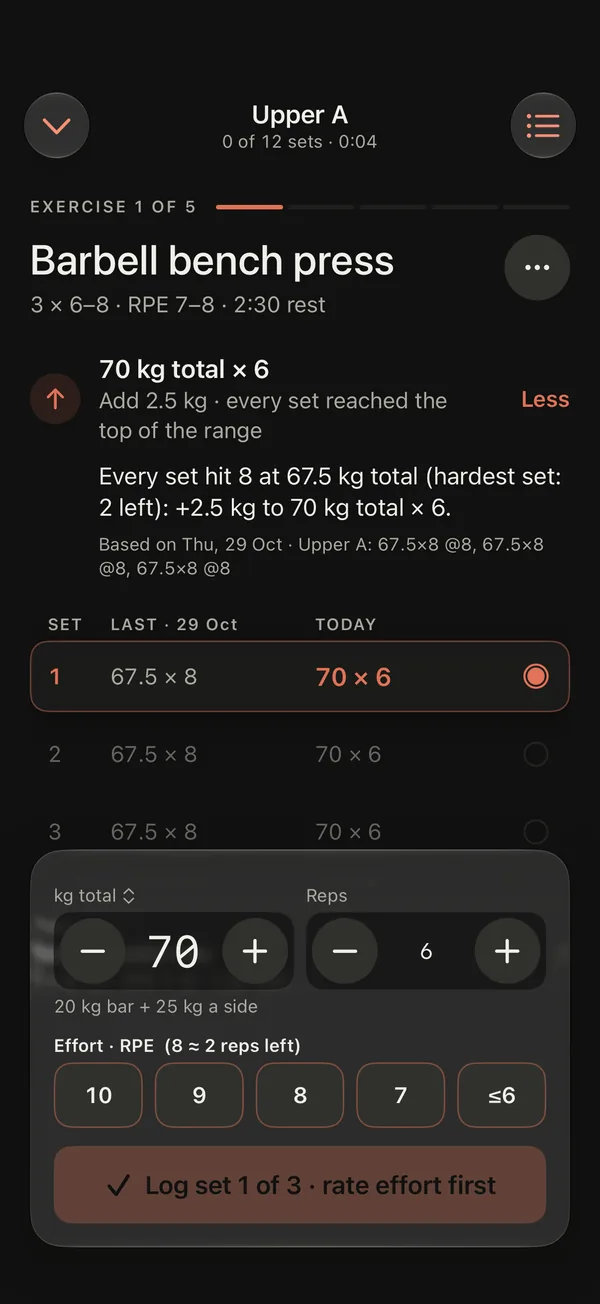
The rule is double progression: keep the weight and add reps until every working set reaches 8 at the planned effort, then add 2.5 kg and go back to 6. The weight drops one step only when no set reaches 6, and one bad day at a weight you've handled before doesn't count. How the rule works, with a calculator.
What the app says after the last session in that example: “Every set hit 8 at 40 kg (hardest set: 2 left): +2.5 kg to 42.5 kg × 6.”
Plates a side, as the app shows them under the weight (20 kg / 45 lb bar):
| Weight | Plates a side |
|---|---|
| 40 kg | 10 kg |
| 42.5 kg | 10 + 1.25 kg |
| 45 kg | 10 + 2.5 kg |
| 135 lb | 45 lb |
| 140 lb | 45 + 2.5 lb |
| 145 lb | 45 + 5 lb |
04
What to swap it for
When the barbell is taken, Gym mode offers swaps for today from the same muscle group and the same kind of movement (the row family), filtered to the equipment you have. The plan stays as written. For the barbell row:
- Pendlay row
- Underhand barbell row
- Seal row
- T-bar row
- Chest-supported T-bar row
- Meadows row
- Dumbbell row
- Chest-supported dumbbell row
05
In the starting plans
| Plan | Day | Prescription |
|---|---|---|
| Push / Pull / Legs | Pull (Wednesday) | 3 × 6–8 |
| Upper / Lower | Upper A (Monday) | 3 × 6–8 |
| Hybrid: Upper / Lower + runs | Upper A (Monday) | 3 × 6–8 |
| Bro split | Back (Tuesday) | 3 × 6–8 |
| Push / Pull / Legs ×2 | Pull A (Tuesday) | 3 × 6–8 |
06
Step by step
- Holding a barbell with a pronated grip (palms facing down), bend your knees slightly and bring your torso forward, by bending at the waist, while keeping the back straight until it is almost parallel to the floor. Tip: Make sure that you keep the head up. The barbell should hang directly in front of you as your arms hang perpendicular to the floor and your torso. This is your starting position.
- Now, while keeping the torso stationary, breathe out and lift the barbell to you. Keep the elbows close to the body and only use the forearms to hold the weight. At the top contracted position, squeeze the back muscles and hold for a brief pause.
- Then inhale and slowly lower the barbell back to the starting position.
- Repeat for the recommended amount of repetitions.
Steps and photos: Free Exercise DB, public domain (Unlicense), as bundled in the app.
Sojourner: Habits & Training
Get the next weight worked out on every set.
Sojourner applies this rule to every set you log and tells you why. Free iPhone beta on TestFlight, no account.
TestFlight public beta · iOS 26 or later · Android in development