Sojourner
Join the beta

Training guide
Back to the gym after a break: 2 weeks, a month or longer
The break matters less than your first two weeks back. Start a little easier than your pride wants, then let your reps tell you when to add weight.
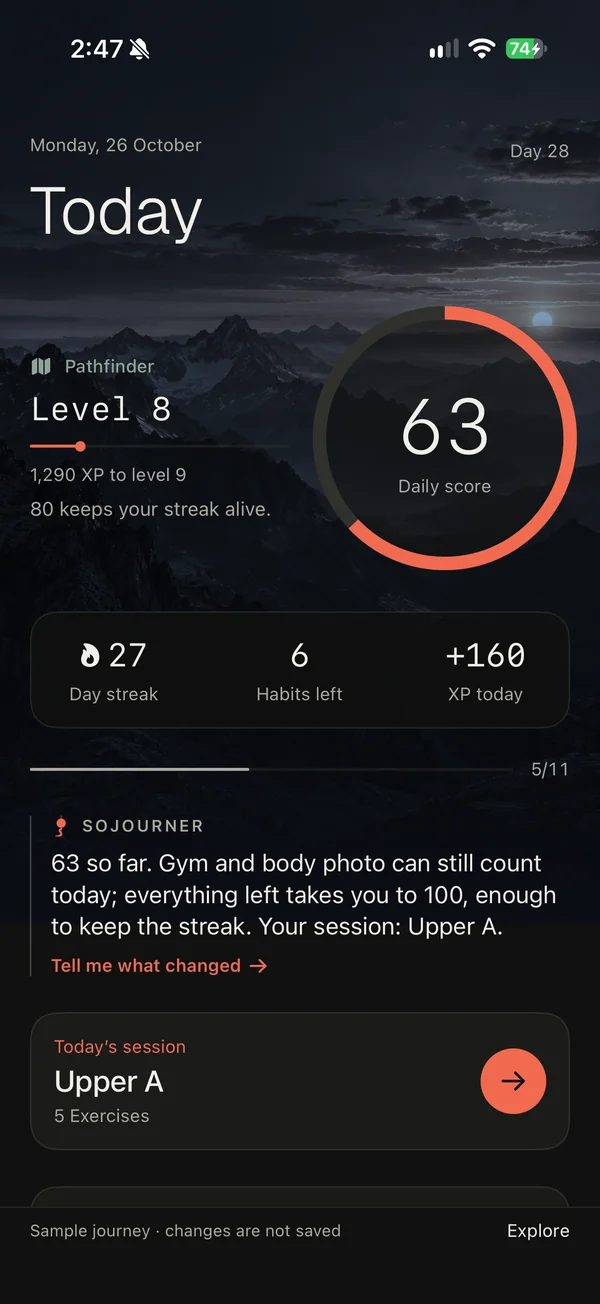
Actual app · sample journey
01
What a break actually costs
Strength does drop when you stop training, and it drops more the longer you stop. A meta-analysis of 103 studies found losses in strength and power after training stopped, growing with the length of the break, and larger in adults over 65 and in people who weren't training regularly beforehand (Bosquet et al., 2013).
Short breaks cost less than they feel like. Lifters who took a full week off in the middle of a 9-week program gained as much muscle as those who trained straight through, and slightly less strength (Coleman et al., 2024). In a smaller study, 14 young men either trained bench press continuously for 24 weeks or took three-week breaks between six-week blocks. By the end, both groups had made similar gains in muscle size and strength; the retraining blocks caught up (Ogasawara et al., 2013). Those are small studies of young, healthy people, so treat them as reassurance, not a rule.
02
Where to start, by the length of the break
No study sets exact cut-offs or percentages for coming back. This is a cautious approach that leans on how hard the sets feel, measured in reps you could still have done (reps in reserve).
| Time off | Start with | The first week or two |
|---|---|---|
| Under 2 weeks | Your last working weights | Your normal plan. If the first session feels heavy, stop each set with a rep or two more in reserve |
| 2 to 4 weeks | Your last working weights | One easy week: aim for the bottom of your rep range and stop well short of failure, then progress as usual |
| 1 to 3 months | A weight you can lift for the bottom of your range with 3 or 4 reps to spare | Add reps before weight, session by session |
| 6 months or more | Light, like a first session: build up to the planned effort over the first sets | Relearn the movements; add reps, then weight |
If you don't know where to start, start lighter. Being a session or two behind costs little, and the reps will show you when to move up.
03
Let your reps decide when to add weight
Once you're back, use the same rule as always: keep the weight until every set reaches the top of your rep range at the effort you planned, then add the smallest step and go back to the bottom of the range. Only drop the weight if it fails the bottom of the range. The double progression calculator applies this to your last session.
04
What not to do
- Don't test your old maxes in the first week. Let the reps climb back first.
- Don't double up to make up for lost time. One session a day, and keep your rest days.
- Don't restart a hard program at full intensity. An easy week, or a step back in the plan, gets you there with less risk of a miserable first week.
If you're coming back from an injury or illness, follow your clinician's advice on when and how to restart.
05
How Sojourner does it
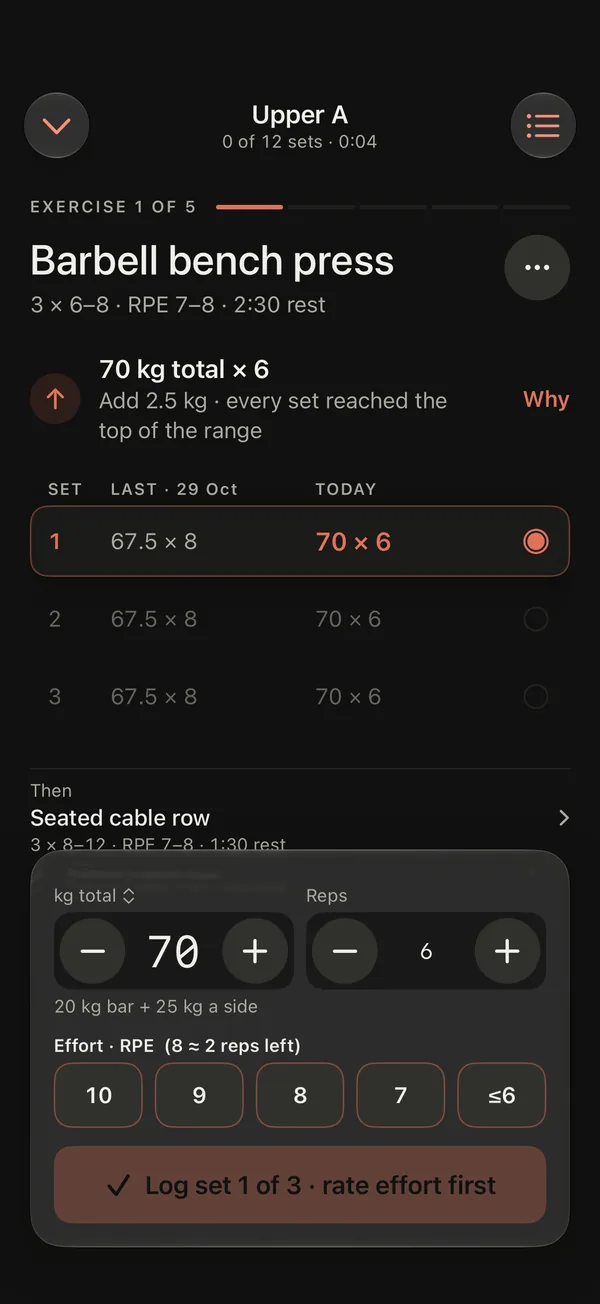
If 14 days go by with no workout recorded (vacations aside), Train offers an easy week back (your last working weights at the bottom of the range, stopping well short of failure), picking the plan up at an earlier week, or carrying on. That 14 days is a practical rule, not a measured point where strength drops. Then every set suggests your next weight from your recent sessions, with the reason. Missed just a session or two? See what to do after a missed workout.
06
Sources
- Bosquet L, et al. Effect of training cessation on muscular performance: a meta-analysis. Scand J Med Sci Sports. 2013;23(3):e140–e149.
- Coleman M, et al. Gaining more from doing less? The effects of a one-week deload period during supervised resistance training on muscular adaptations. PeerJ. 2024;12:e16777.
- Ogasawara R, Yasuda T, Ishii N, Abe T. Comparison of muscle hypertrophy following 6-month of continuous and periodic strength training. Eur J Appl Physiol. 2013;113(4):975–985.
Sojourner: Habits & Training
Coming back is built in.
After two weeks without a workout, Sojourner offers an easy week back or an earlier week of your plan, then suggests each weight from your sets. Free iPhone beta, no account.
TestFlight public beta · iOS 26 or later · Android in development