Sojourner
Join the beta

Training guide
Missed a workout? What to do next, without starting over
One missed session changes very little. What you do next matters more: don't cram it in, don't restart the program, and take the simplest way back that still keeps your hard days apart.
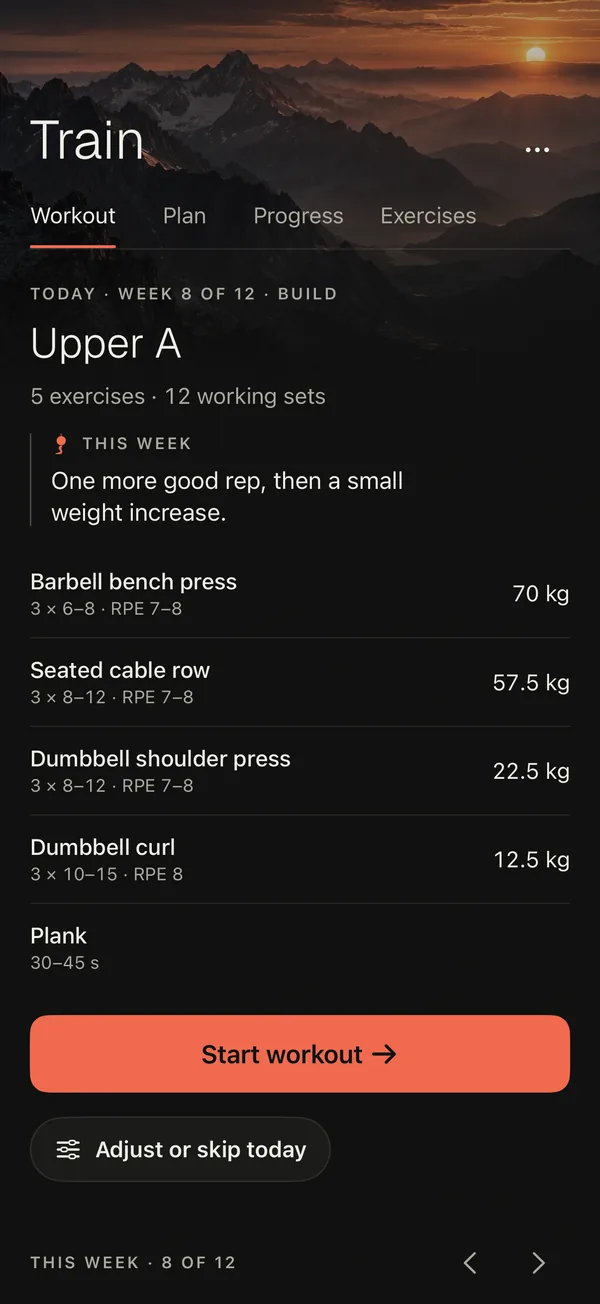
Actual app · sample journey
01
One missed session costs less than it feels like
In a 12-week study of how habits form, missing a single opportunity didn't materially affect how automatic the habit became (Lally et al., 2010). What predicted success was coming back.
Your strength doesn't vanish in a few days either. Losses from stopping training grow with the length of the break, and they're larger in older and less trained people (Bosquet et al., 2013). In a trial where lifters took a full week off in the middle of a 9-week program, muscle growth matched the group that trained straight through; strength gains were somewhat smaller (Coleman et al., 2024). A missed day or two is noise. A missed month is a reason to ease back in.
02
Four ways back, simplest first
When a session is missed this week, these are the options worth considering, roughly in this order:
- Fit it into an open day. Move the missed session to a free day this week, as long as it doesn't land the day before or after another session for the same muscles.
- Swap it for a light day. If the week has a cardio or mobility day, train the missed session there and let the light day go.
- Shift the rest of the week. Do the missed session next and push the others along, if the week has room.
- Carry on as written. Sometimes nothing fits without cramming. Then the right move is to skip it and do the next session as planned.
Three rules keep this from turning into catch-up training:
- One session a day. Doubling up to "make it up" mostly makes the next sessions worse.
- No more than one extra session in any 7 days, and keep at least one day off.
- Keep the same muscles apart. Training each muscle group on 2–3 days a week is the usual guidance (Garber et al., 2011); back-to-back days for the same muscles isn't.
An example week
A four-day Upper/Lower plan, with Tuesday's lower-body session missed:
| Mon | Tue | Wed | Thu | Fri | Sat | |
|---|---|---|---|---|---|---|
| Plan | Upper A | Lower A | rest | Upper B | Lower B | rest |
| Missed | Upper A | |||||
| Way back | Upper A | Lower A | Upper B | Lower B | rest |
Wednesday is open, and Lower A there isn't next to another lower-body day (Thursday is upper), so filling Wednesday keeps the whole week. If Wednesday weren't free, Saturday wouldn't work either: it puts Lower A the day after Lower B. Then the choice is shifting the week (Lower A Thursday, Upper B Friday, Lower B Saturday) or carrying on as written.
03
After two weeks or more off
Don't try to make up what you missed. Two common ways to restart:
- An easy week. Use your last working weights, but stop at the bottom of your rep range and well short of failure. No progression that week; normal training after.
- Step back in the plan. Pick up a week or two earlier in the program than where you stopped.
Back to the gym after a break covers where to start your weights. Sojourner offers both after 14 days without a recorded workout. That number is a practical rule, matched to its easy week after a vacation; no study fixes an exact point where a break needs a reset.
04
When you only have 30 minutes
Do the main lifts first: the big compound movements and anything in a low rep range. Accessory work is what to trim. A short session that keeps the important lifts is better than a skipped one.
05
What not to do
- Don't double up the next day or add punishing extra cardio. That's how one missed day becomes a missed week.
- Don't restart the program from Week 1 after a single miss.
- Don't cut your weights because you missed a session. One week off didn't change muscle size in the study above; ease the effort, not the load.
06
How Sojourner handles it
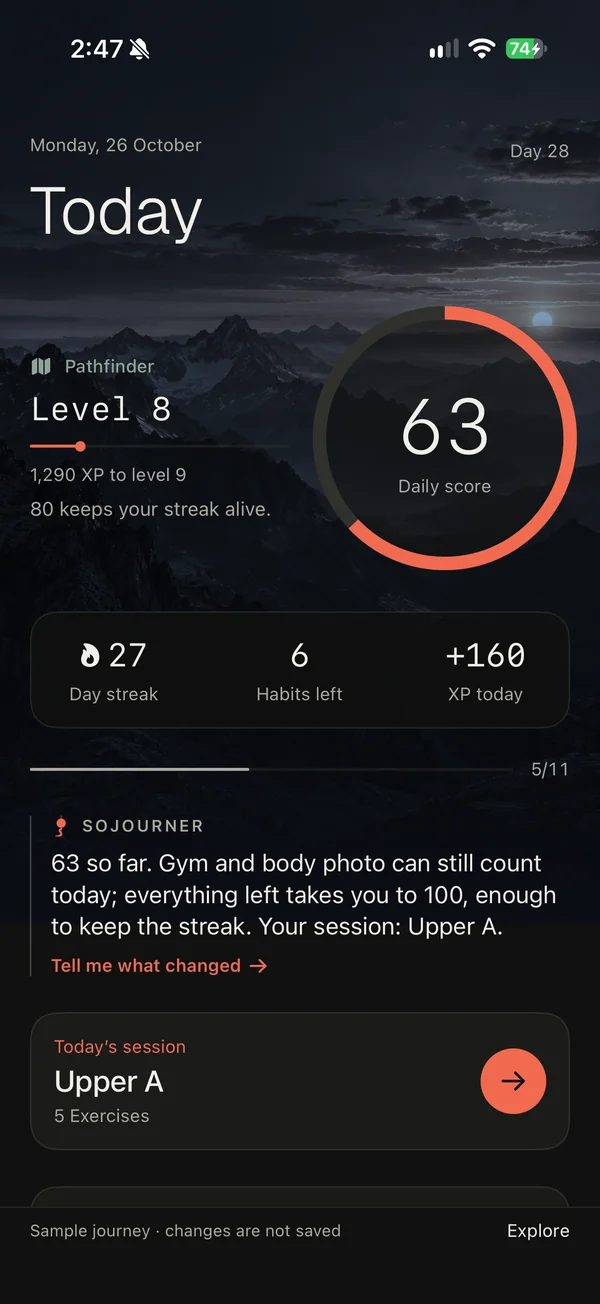
When a session goes unrecorded, Train shows what was missed and the ways back, recommended first: fill an open day, swap a light day, shift the week, or carry on. It follows the rules above, it never puts two sessions on one day, and nothing changes until you apply a choice. A moved session isn't a completed one: it still has to be done for the gym habit to count.
Your daily score is built from the habits you chose, and a day at 80 or more keeps the streak, so one off day doesn't erase weeks of showing up. Days off and vacations get a lighter checklist instead of a broken streak.
07
Sources
- Lally P, van Jaarsveld CHM, Potts HWW, Wardle J. How are habits formed: modelling habit formation in the real world. Eur J Soc Psychol. 2010;40(6):998–1009.
- Bosquet L, et al. Effect of training cessation on muscular performance: a meta-analysis. Scand J Med Sci Sports. 2013;23(3):e140–e149.
- Coleman M, et al. Gaining more from doing less? The effects of a one-week deload period during supervised resistance training on muscular adaptations. PeerJ. 2024;12:e16777.
- Garber CE, et al. Quantity and quality of exercise for developing and maintaining cardiorespiratory, musculoskeletal, and neuromotor fitness in apparently healthy adults. ACSM Position Stand. Med Sci Sports Exerc. 2011;43(7):1334–1359.
Sojourner: Habits & Training
A plan that bends instead of breaking.
Miss a session and Sojourner shows where it can still fit this week, recommended option first. Nothing changes until you choose. Free iPhone beta on TestFlight.
TestFlight public beta · iOS 26 or later · Android in development