Sojourner
Join the beta

Food tool
Calorie and protein calculator: a starting point from your weight
A simple starting point: 11, 14 or 15 kcal per pound of body weight to lose, maintain or gain, and 1.9 g of protein per kg. For 80 kg (176 lb) and losing weight, that's 1,950 kcal and 150 g of protein a day. It's a first guess, not a measurement: your weekly average weight tells you whether to change it.
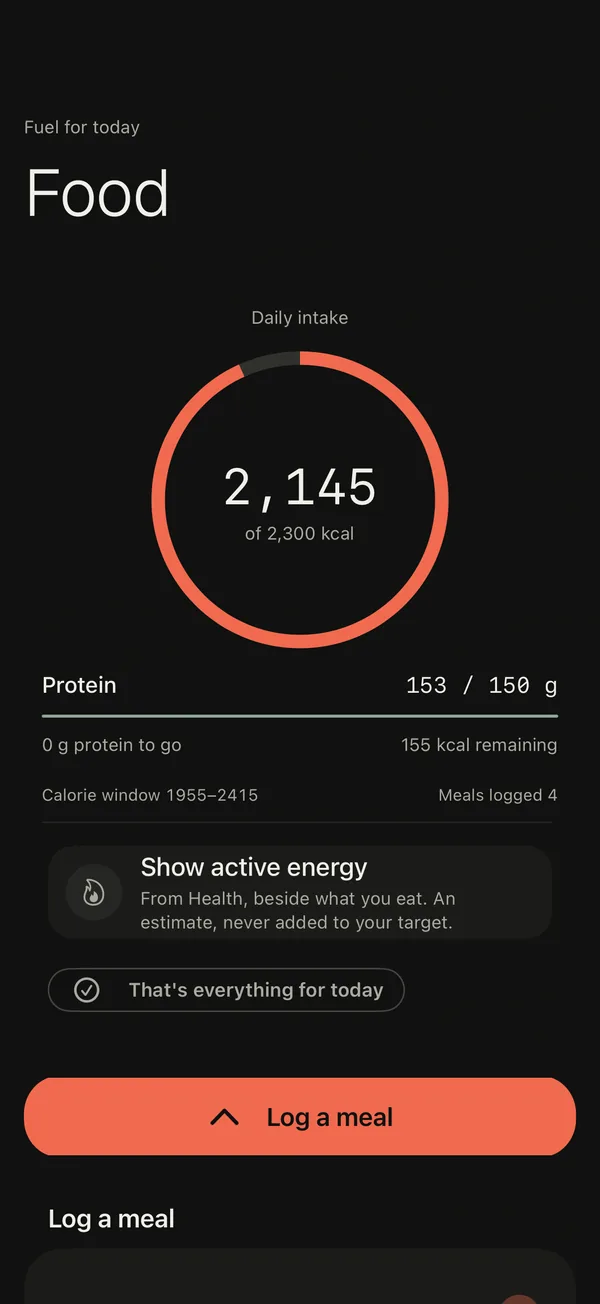
Actual app · sample journey
Where should I start?
Nothing you type leaves this page.
The calculator needs JavaScript. The rule and a table are below.
01
The rule
- Calories: body weight in pounds × 11 to lose, × 14 to maintain, × 15 to gain, rounded to the nearest 50. Never below 1,600 kcal.
- Protein: 1.9 g per kg of body weight, rounded to the nearest 5 g, up to 220 g.
| Body weight | Lose | Maintain | Gain | Protein |
|---|---|---|---|---|
| 55 kg (121 lb) | 1,600 kcal | 1,700 kcal | 1,800 kcal | 105 g |
| 60 kg (132 lb) | 1,600 kcal | 1,850 kcal | 2,000 kcal | 115 g |
| 70 kg (154 lb) | 1,700 kcal | 2,150 kcal | 2,300 kcal | 135 g |
| 80 kg (176 lb) | 1,950 kcal | 2,450 kcal | 2,650 kcal | 150 g |
| 90 kg (198 lb) | 2,200 kcal | 2,800 kcal | 3,000 kcal | 170 g |
| 100 kg (220 lb) | 2,450 kcal | 3,100 kcal | 3,300 kcal | 190 g |
| 110 kg (243 lb) | 2,650 kcal | 3,400 kcal | 3,650 kcal | 210 g |
| 120 kg (265 lb) | 2,900 kcal | 3,700 kcal | 3,950 kcal | 220 g |
02
Why these numbers
Protein. In a meta-analysis of 49 trials, extra protein added to strength and muscle gains from resistance training up to about 1.6 g per kg a day, with little further benefit above that (Morton et al., 2018). The International Society of Sports Nutrition puts 1.4–2.0 g per kg a day as enough for most people who exercise, and notes higher intakes may help keep lean mass during a calorie deficit (Jäger et al., 2017). 1.9 g per kg sits inside that range, with room for the deficit.
Calories. The multipliers are a rule of thumb, not a measurement. What you actually burn depends on your size, body composition and how much you move. Food logs drift too: in a classic study, people who said they couldn't lose weight on under 1,200 kcal a day were eating far more than they recorded (Lichtman et al., 1992). That's why the starting number matters less than what happens next.
03
Adjust from your trend, not one day
Weigh in most mornings and compare weekly averages. If your 7-day average isn't moving the way you want after two or three weeks, change calories by a small amount and give it another few weeks. How to adjust a calorie deficit covers when and by how much.
04
Who this isn't for
This is general information for healthy adults. If you're pregnant or breastfeeding, under 18, have kidney disease, diabetes or another medical condition, or have a history of disordered eating, talk to a doctor or registered dietitian before setting targets.
05
In Sojourner
Sojourner sets these exact starting targets from the weight and goal you enter, and you can edit them. For weight-loss goals, a weekly check-in can adjust calories from your 7-day average weight, and it never goes below 1,600 kcal.
06
Sources
- Morton RW, et al. A systematic review, meta-analysis and meta-regression of the effect of protein supplementation on resistance training-induced gains in muscle mass and strength in healthy adults. Br J Sports Med. 2018;52(6):376–384.
- Jäger R, et al. International Society of Sports Nutrition position stand: protein and exercise. J Int Soc Sports Nutr. 2017;14:20.
- Lichtman SW, et al. Discrepancy between self-reported and actual caloric intake and exercise in obese subjects. N Engl J Med. 1992;327(27):1893–1898.
Sojourner: Habits & Training
Targets that adjust from your weight trend.
Sojourner sets these starting targets, then a weekly check-in can adjust calories from your 7-day average weight. Free iPhone beta on TestFlight.
TestFlight public beta · iOS 26 or later · Android in development