Sojourner
Join the beta

Training guide
Deload week: when to take an easy week, and what to change
A deload is a short, planned easy week. Keep your training days and exercises, do fewer reps or sets, and stop well short of failure, so you come back to normal training fresher. Competitive lifters in one survey took one about every five to six weeks, for about six days. There's little trial evidence on how often you need one, so read that as a habit of experienced lifters, not a rule.
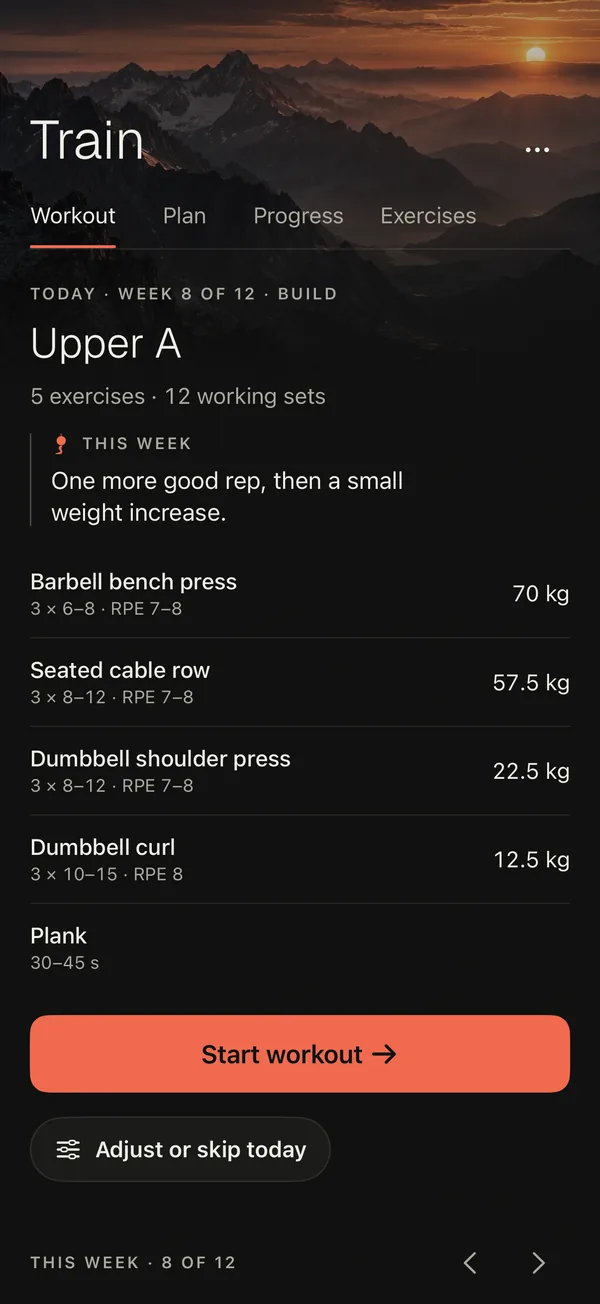
Actual app · sample journey
01
What a deload is
A 2023 consensus of strength and physique coaches defined it as "a period of reduced training stress designed to mitigate physiological and psychological fatigue, promote recovery, and enhance preparedness for subsequent training" (Bell et al., 2023). In plain words: an easier week on purpose, so the weeks after it go better.
It isn't a week off. You still train on your usual days.
02
What experienced lifters actually do
A 2024 survey of 246 competitive strength and physique athletes, with about eight years of training on average, found that all of them deloaded (Rogerson et al., 2024):
- ~6 daysa typical deload
- every 5–6 weekson average (5.6 ± 2.3)
- 246athletes surveyed
During a deload they:
- cut volume, with fewer reps per set and fewer sets per week;
- kept the same number of training days;
- lowered the effort, stopping with more reps in reserve, and often lowered the weight;
- kept the same exercises.
Most planned their deloads ahead of time. Some also deloaded when performance stalled, or when soreness or joint aches built up. This is what experienced lifters report doing, not proof that it's needed, and the survey didn't measure outcomes.
03
Does an easy week cost you anything?
Very little, as far as the evidence goes. In a trial where lifters stopped training entirely for one week in the middle of a 9-week program, lower-body muscle growth matched the group that trained straight through. Strength gains were somewhat smaller (Coleman et al., 2024). A deload is gentler than that: you keep training, just easier.
04
How to run one
Pick one way and keep everything else the same:
- Same weight, fewer reps, more left in the tank. Keep your working weights, do the bottom of your rep range, and stop each set with 3–4 or more reps in reserve (see RIR vs RPE). This keeps the feel of your normal loads without the fatigue.
- Fewer sets. Drop a set or two from each exercise, at your usual weights and reps, but nothing close to failure.
- Lighter weights. Keep sets and reps, and use clearly lighter loads for the week.
Then go back to your last working weights the week after. Don't add weight because the deload felt easy, and don't start the program over.
An example
Squat, normally 3 sets of 6–8 at 100 kg, stopped with 2 reps left:
| Sets × reps | Weight | Reps left | |
|---|---|---|---|
| Normal week | 3 × 6–8 | 100 kg | 2 |
| Easy week (way 1) | 3 × 6 | 100 kg | 4+ |
| Week after | 3 × 6–8 | 100 kg | 2 |
05
When to take one
- On a schedule. Many programs end each block with an easy week. The survey's lifters averaged one every 5–6 weeks.
- When you've stalled. If the same weight and reps have felt harder for a couple of sessions, an easy week is a cheap thing to try before changing the program.
- After a break. Coming back after two weeks or more, start with an easy week instead of making up what you missed. Back to the gym after a break covers where to start your weights.
If you're adding reps or weight most weeks and feel fine, nothing in the research says you must deload on a fixed schedule.
06
How Sojourner does it
In Sojourner's plan editor, you can set each week of a plan to one of three kinds:
- Build: the weight goes up when every working set reaches the top of the rep range at the planned effort.
- Hold: no progression; the same weight and reps each session.
- Easy: no progression; the weight stays, and the target drops to the bottom of the rep range. Sojourner never lowers the weight for an easy week, so the next week picks up where you were.
Eight of the ten starting plans run 8 weeks this way: week 1 finds your weights, weeks 2–7 build, and week 8 is easy. After 14 days without a workout, Sojourner offers an easy week back instead of making up what was missed.
07
Common questions
Deload or a full week off?
Either can work. A deload keeps the habit of training on your usual days, which is the part that's hardest to restart. A week off cost little muscle in the trial above.
Will I lose muscle in a deload week?
A full week without training didn't reduce muscle growth in that trial, so an easier week of training is unlikely to.
How often should beginners deload?
Less is known about beginners; the survey was of experienced athletes. If your lifts still go up most weeks, follow your program's easy weeks and take an extra one only when you feel run down.
Should I deload by cutting weight or reps?
The athletes surveyed mostly cut both volume and effort. Keeping the weight and cutting reps is the simplest, because you go straight back to the same weight afterwards.
08
Sources
- Bell L, et al. Integrating deloading into strength and physique sports training programmes: an international Delphi consensus approach. Sports Med Open. 2023;9(1):87.
- Rogerson D, et al. Deloading practices in strength and physique sports: a cross-sectional survey. Sports Med Open. 2024;10(1):26.
- Coleman M, et al. Gaining more from doing less? The effects of a one-week deload period during supervised resistance training on muscular adaptations. PeerJ. 2024;12:e16777.
Sojourner: Habits & Training
Easy weeks, planned in.
Most of Sojourner's starting plans end with an easy week, and you can mark any week of your plan as Build, Hold or Easy. Free iPhone beta on TestFlight.
TestFlight public beta · iOS 26 or later · Android in development